
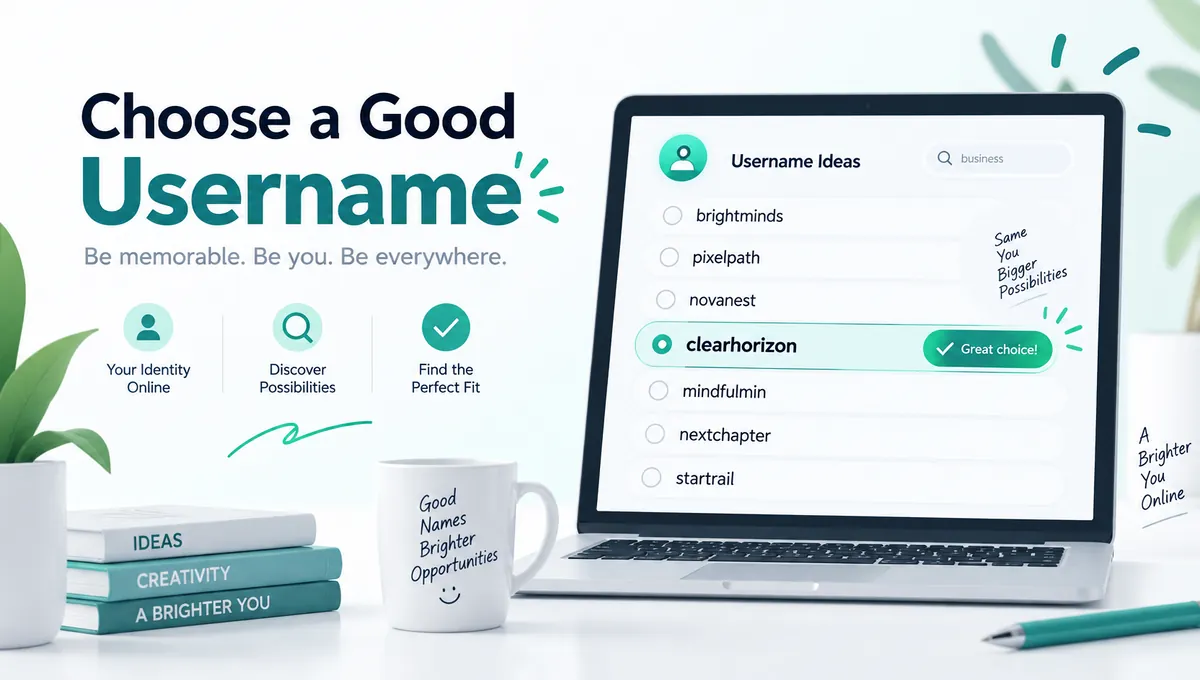
Learning how to choose a good username is not just about finding something creative. A username becomes part of how people recognize, remember, search for, or interact with you online, so a clever idea can quickly become frustrating if it is hard to spell or explain.
A strong username should fit the purpose of the account, feel natural to use, and avoid unnecessary complexity. It should also make sense for your privacy needs, the audience you want to reach, and the way you may use the account later.
Quick Answer
Choose a username that fits the account, is easy to read, say, spell, and remember, and does not reveal personal information you would rather keep private. Compare several options, remove names that rely on confusing spelling or unnecessary numbers, check availability directly on the platforms you plan to use, and think about whether the name will still suit you later. If your first choice is taken, make a meaningful change instead of forcing it with random characters.
Start With the Job Your Username Needs to Do
A good username is not the same for every account. Before thinking about style, decide what you want the username to accomplish and who you expect to see it.
A public creator profile needs to be easy to remember and search. A professional username may benefit from your real name or field, while a gaming username can be more playful, fictional, or personality-driven.
A private forum or hobby account creates a different situation. If you do not want people connecting that account with your real identity, a distinctive version of your full name may work against your privacy goal.
Ask yourself these questions before choosing:
- Is this account public, personal, professional, or private?
- Do I want strangers to remember and search for this username?
- Do I want this account connected with my other profiles?
- Does the username need to represent me, a project, or a brand?
- Am I likely to use the same identity a few years from now?
These answers give you a useful direction before you start comparing username ideas. They also prevent you from choosing a name simply because it looks interesting for a few seconds.
What Makes a Good Username?
A good username usually balances clarity, memorability, personality, and practical use. It does not need to win every category, but it should not create obvious problems every time someone tries to read, remember, or search for it.
| Quality | What to Ask |
|---|---|
| Readable | Can someone understand the words without studying them? |
| Memorable | Is there something simple or distinctive enough to remember later? |
| Easy to say | Can you tell someone the username without a long explanation? |
| Easy to spell | Could someone type it after hearing it? |
| Relevant | Does it match the account, personality, topic, or identity? |
| Flexible | Will it still make sense if your interests change? |
| Privacy-aware | Does it avoid personal information you do not want public? |
| Practical | Can people search, type, and share it without unnecessary friction? |
Do not confuse a unique username with a good username. Strange spelling, extra symbols, or random numbers may make a name more unusual, but they can also make it harder to remember.
The goal is enough personality to feel distinctive without making the username difficult to use.
Build a Shortlist Instead of Searching for One Perfect Name
Trying to create one perfect username immediately can make the process harder. Start with a small group of ideas, then compare them using the same standards.
You can build ideas from your nickname, interests, personality, favorite words, topic, role, hobby, or a pair of words that sound natural together. If you need more starting points, our Username Generator can create options that you can then evaluate using the checks in this guide.
Generated suggestions should be treated as ideas, not guarantees. A generated username may already be in use, may not fit every platform’s rules, or may need editing before it matches your purpose.
A shortlist of five useful candidates is normally more helpful than a list of fifty names you have not seriously evaluated.
Use These Tests Before You Choose a Username
A username may look good while you are staring at it and still perform poorly in real use. Testing the name in a few ordinary situations can reveal problems that are easy to miss during brainstorming.
Say the Username Out Loud
Read the username exactly as you would say it to another person. If you immediately need to explain which letters are numbers, where an underscore appears, or how an unusual spelling works, the name has extra friction.
This matters for social media handles, gaming usernames, creator profiles, communities, and even personal accounts. A username becomes easier to share when its pronunciation naturally leads people toward the correct spelling.
Try to Spell It From Memory
Look away from the username for a few minutes, then type it again. If you cannot remember whether you used i, y, 1, an underscore, or an extra letter, another person may have the same problem.
Creative spelling is not automatically bad. It becomes a problem when the spelling trick is doing more work than the actual name.
Read It as One Continuous String
Most usernames appear without spaces, which can change how two words look when they are joined. Check whether the word boundaries are still obvious and whether the combined text accidentally reads like something you did not intend.
Pay special attention to similar-looking characters such as O and 0, l and 1, or repeated letters at word boundaries. A username should not need capitalization just to become understandable.
Imagine Someone Searching for It Tomorrow
Think about a person who heard your username once and wants to find the profile a day later. Would they remember the main words and know how to type them?
This is a better memorability test than simply asking whether the username looks catchy. A memorable username gives another person enough information to find you again.
Check the Privacy Cost
A username can reveal more than you planned. Your full name, birth year, exact location, school, employer, or other identifying details may make an account easier to connect with you.
That may be useful for a public professional identity, but it may be unnecessary for a gaming account, private community, or personal hobby profile. Username privacy depends on what you want people to know and which identities you want connected.
Give It the Future Test
Picture the username a few years from now. A name based on a temporary employer, current age, passing trend, short-lived joke, or extremely narrow interest may stop feeling relevant faster than you expect.
You do not need a name that works forever. You simply want to avoid an obvious reason to dislike or replace it soon.
How Long Should a Username Be?
There is no universal ideal username length because platform rules and account purposes differ. Shorter names can be easier to type and remember, but reducing a username too aggressively can make it vague, cryptic, or difficult to understand.
A better rule is to remove characters that do not add useful meaning. If two usernames communicate the same idea, the cleaner one is usually easier to remember and share.
If compact handles are especially important for your account, our guide to Short Usernames covers that style in more detail. For this article, length is only one part of the decision rather than the entire goal.
Should You Use Numbers, Underscores, or Symbols?
Numbers and separators are not automatically bad. A meaningful number or a simple separator can make an unavailable username usable without making it difficult to understand.
Problems begin when several fixes are stacked together. A username such as Name_47291_x may technically work, but remembering and saying it becomes much harder than remembering a clean word combination.
Use numbers when they have a reason you are comfortable sharing. Avoid using a birth year simply because it is easy to remember if you would rather not reveal that detail publicly.
The same principle applies to underscores, periods, and unusual spelling. Use them when they improve the username, not just because every cleaner option is unavailable.
What Should You Do If Your Username Is Taken?
A username already being taken is one of the most common reasons people ruin a good idea. The first reaction is often to add random digits, but that should not always be your first choice.
Try changing the concept while preserving the part you actually like. You can change a secondary word, reverse the order, add a relevant modifier, shorten a word carefully, or try another combination with the same theme.
For example, imagine that NorthPixel is unavailable. Alternatives such as PixelNorth, NorthPixelStudio, or another meaningful variation may be easier to remember than NorthPixel84729.
There is also a point where you should stop fixing the original idea. If making it available requires unusual spelling, several numbers, multiple separators, and an explanation every time you share it, another username may simply be better.
Do Not Let “Unique” Become “Confusing”
People often search for a unique username because they do not want to look generic. That is reasonable, but uniqueness becomes less useful when nobody can remember the result.
A creative username can still use familiar words, clear sounds, and normal spelling. Distinctiveness can come from the combination of words rather than from making each word difficult to recognize.
For example, two ordinary words paired in an unexpected way can create a strong screen name without forcing strange characters into it. The best creative usernames often feel intentional rather than random.
Should You Use Your Real Name?
Using your real name can make sense when you want an account connected directly to your professional identity, public work, portfolio, or creator profile. It can help people who already know your name recognize the account.
That does not make a real-name username the right choice for every situation. Gaming, private communities, experimental projects, or accounts where you want some separation may be better served by a nickname, handle, or unrelated screen name.
Think beyond whether using your name is possible. Decide whether making that connection serves the purpose of the account.
Should You Use the Same Username Everywhere?
Cross-platform consistency can be useful when you intentionally want one recognizable online identity. Someone who discovers your profile on one service may have an easier time finding the same creator, project, or public identity elsewhere.
There is also a privacy trade-off. Reusing one unusual username across unrelated accounts can make those profiles easier to connect, even when you did not intend them to represent one identity.
If being discoverable is the goal, consistency can help. If separation is the goal, using different usernames for different areas of your online life may be the more sensible choice.
For a platform-specific public profile, naming needs can also change with the audience. Our Instagram Username Ideas guide focuses on that narrower use case without turning this general guide into a platform-specific article.
Username vs Display Name: Know the Difference
A username, handle, display name, profile name, and screen name are sometimes used loosely, but platforms may treat them differently. A username is commonly the unique account identifier, while a display name is often the more flexible name shown publicly.
Exact rules vary by service, so check the platform directly before making a final decision. Do not build your entire username around a feature or format that a particular platform may not support.
This distinction can also make your choice easier. You may be able to keep a clean username while using a fuller real name, nickname, business name, or descriptive phrase as the display name.
Check Availability Before You Get Attached to a Name
Username availability should be checked directly on every platform that matters to you. A name being available on one site does not mean it will be available on another.
Do this before designing graphics, telling people your handle, or building an identity around the exact spelling. Generated username ideas should never be treated as guaranteed unique or guaranteed available.
If the username represents a business, product, or commercial project, platform availability is only one part of the check. You may also need to review relevant brand, domain, and trademark conflicts before investing heavily in the name.
How to Choose Between Your Final Username Options
Once you have three to five serious candidates, stop generating new ideas for a moment. Compare the finalists using the same practical questions instead of choosing whichever one feels exciting at that second.
Use this sequence:
- Purpose: Does the username fit the account?
- Say: Can you pronounce it naturally?
- Spell: Can someone type it after hearing it?
- Read: Is it clear when written without spaces?
- Remember: Could someone recall the important parts later?
- Privacy: Does it reveal or connect more than you want?
- Availability: Can you actually use it where it matters?
- Future: Are you comfortable keeping it if your interests change?
A candidate does not need to be the shortest, coolest, or most unusual option. It should have the fewest meaningful weaknesses for the way you plan to use it.
If one username keeps needing explanations or exceptions, treat that as useful information. You may like the idea, but another candidate may be the better username.
Final Username Checklist
Before committing to a username, run through one final check. This catches small problems before they become part of an account you use regularly.
- The username fits the purpose of the account.
- It is easy enough to read at a glance.
- You can say it without explaining every character.
- Someone can reasonably spell it after hearing it.
- The words or sounds are memorable.
- Its length does not include unnecessary clutter.
- Numbers and separators have a useful reason.
- It avoids personal information you prefer to keep private.
- You have checked username availability directly.
- You know whether you want the same handle across other platforms.
- You are comfortable using the name beyond a current trend or phase.
- It does not imitate another person, creator, or brand in a misleading way.
Do not worry if one candidate is not perfect on every point. The purpose of the checklist is to expose problems that matter, not to reject a usable username over tiny details.
Choose a Username That Works Beyond the First Impression
The best way to choose a good username is to judge how it works, not just how it looks. A strong choice fits the account, is easy enough to say and remember, respects the level of privacy you want, and does not depend on unnecessary complexity.
Once you find a candidate that passes those checks, stop searching for a mythical perfect username. Check its availability, make sure you are comfortable using it, and choose the name that creates the least friction for you and the people who need to recognize it.